
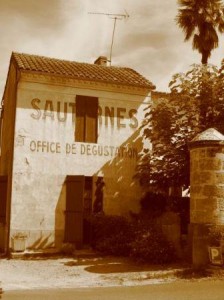
Learn everything about Sauternes, Barsac, sweet white Bordeaux Wine in our complete Sauternes guide, with a history of the appellation, wine tasting notes, the top ten facts about Sauternes, detailed profiles on all the best wines, vineyards, and chateau with wine and food pairing tips and buying guides for all the top producers of sweet, white Bordeaux wine from Sauternes.
If you want to read about other Bordeaux wine producers in different Bordeaux appellations: Links to all Bordeaux Wine Producer Profiles If you are interested in learning more about Bordeaux wine, we offer numerous articles on everything about Bordeaux wine, from a history of the Bordeaux region and the famous 1855 Classification to the grapes used to produce Bordeaux wine and even vintage summaries covering Bordeaux wine from 1900 to today: All About Bordeaux Wine Guide
The complete guide to all the best chateaux, wines, vineyards and producers in Sauternes:
Map of Sauternes Vineyards and Chateaux
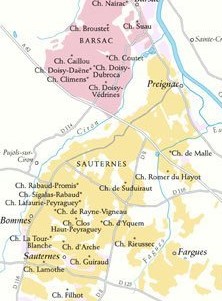
- d’Arche
- Bastor Lamontagne
- Broustet
- Caillou
- Climens
- Clos des Lunes
- Clos Haut Peyraguey
- Coutet
- Doisy Daene
- Doisy Dubroca
- Doisy Vedrines
- de Fargues
- Filhot
- Gilette
- Guiraud
- La Tour Blanche
- Lafaurie-Peyraguey
- Lamothe Despujols
- Lamothe Guignard
- de Malle
- de Myrat
- Nairac
- Raubaud Promis
- Raymond Lafon
- Rayne Vigneau
- Rieussec
- Romer
- Romer du Hayot
- Sigalas Rabaud
- Suau
- Suduiraut
- d’Yquem
The Taste of Sauternes: There are numerous styles of sweet, white Bordeaux wine that come from Sauternes. There are the sweet, honey-drenched wines of Barsac, which have many of the flavors of d’Yquem, but not the concentration. The Bordeaux wine from Sauternes are richer.
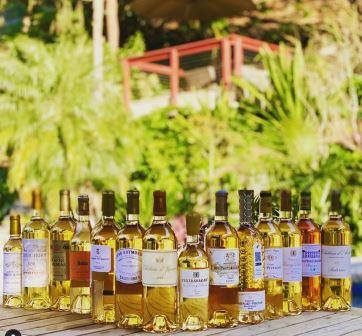
In Sauternes, it’s easy to find pineapple, peaches, flowers, pears, apricots, nectarines, orange, vanilla, custard, butterscotch, coconut, and especially honey are not uncommon.
While you find similar flavors in Barsac, the wines from Barsac are often slighter lighter in weight and can show more acidity.
When the wines of Sauternes and Barsac age, they can more flavors of caramel, brioche, butterscotch and even chocolate, as well develop more of a candied orange character. These are unique wines are best served slightly chilled, perhaps close to 60 degrees.
Sauternes are best enjoyed with salty cheese, spicy food, and of course the best pairing of all, Foie Gras. While Sauternes are considered dessert wines, due to their high levels of sugar, more often than not, they do not pair well with dessert. Sauternes and other sweet wines need to be sweeter than what you are eating.
Sauternes wine and food pairings. While many people feel sweet wines are just for dessert, that is not the case. Sauternes and oysters on the half shell are a great wine and food pairing.
Depending on the preparation, Sauternes can be served with seafood dishes, especially shellfish, lobster, crab. Foie gras and Sauternes, with their natural sweet, salty and savory characteristics is a classic wine and food pairing.
Sauternes can also be paired with roasted chicken, veal, and pork dishes that are either spicy or prepared with a touch of sweetness.
Sweet Bordeaux wines can also be served with spicy Asian cuisine, or other, lightly spiced foods, as sweet and spicy often make for a perfect pairing. Cheese, hard and soft is another great pairing for Sauternes, especially blue cheese or other cheese that contains a high salty, or mineral content and flavor.
Overview of Sauternes: Sauternes covers a large area. Sauternes is located about 25 miles southeast of the city center of Bordeaux, at the Southern end of Graves. The entire Sauternes appellation has 2,002 hectares under vine.
This can be divided into 5 separate communes, each with its own unique terroir. Sauternes covers 1,599 hectares. Barsac is 403 hectares, Bommes has 380 hectares planted. Preignac has 565 hectares and the smallest commune in Sauternes is Fargues, with 190 hectares.
Most chateaux in Sauternes are small, especially when compared to the Medoc. Less than 20 chateaux are more than 20 hectares in size. Close to 160 producers have less than 5 hectares under vine. In total, Sauternes produces more than 480,000 cases of wine each year.
This is divided between Barsac, which produces about 130,000 cases of wine, and Sauternes, which produces roughly 350,000 cases of wine each vintage.
The terroir and soil of Sauternes: Sauternes and Barsac are situated close to the Garonne and Ciron rivers. Those bodies of water, with their different temperatures aids in the development of Noble Rot or Botrytis.
This takes place because the bodies of water, with their different temperatures, helps to create the early morning misty conditions. In the best vintages, the early morning mist and fog give way to warm afternoons, which allows the much-desired rot to develop.
The terroir in the appellation is varied, with different degrees of chalk, limestone, sand, clay and gravel in the soils which rest over an alluvial bed.
There are also gentle rolling hills and slopes with elevations. The elevations in Sauternes range from 3 meters up to 80 meters, (262 feet!) The highest peak in Sauternes is located on the top of the hill at Chateau d’Yquem at 80 meters!
To get an idea on how the soil and terroir of Sauternes and Barsac compares to the other important appellations in Bordeaux; The terroir and soil of Bordeaux
The Top Ten Facts You Need to Know about Sauternes
#1 Sauternes is the most expensive wine to produce in all of Bordeaux.
#2 Sauternes was classified along with the red wines of the Medoc in 1855.
#3 Dry white Bordeaux wine from vines planted in Sauternes is only allowed to be sold as generic Bordeaux Blanc. The reason is, only sweet wines can be sold as Sauternes.
#4 Before the Phylloxera epidemic, Sauvignon Blanc was the key grape planted in Sauternes. Today, the most important grape in Sauternes is Semillon.
#5 Nobody knows when the process of making sweet wine from grapes attacked by Botrytis actually started taking place in Sauternes.
#6 No producer in Sauternes argues about the best producer in the region. They all agree it is Chateau d’Yquem.
#7 Sauternes wine does not pair well with dessert, due to its high sugar levels. Sauternes is best paired with salty or spicy cuisine and of course, cheese.
#8 Sauternes has the widest range of drink-ability of any of the major Bordeaux appellations. The wines can be enjoyed on release, in their youth, or middle years or they can age in the best of cases for decades or longer.
#9 One of the top producers of Sauternes, Chateau La Tour Blanche is actually a wine school.
#10 May 8 is International Sweet Wine Day the perfect day for opening that special bottle of Sauternes!
The best vintages of Sauternes and Barsac Wines are: 2023, 2022, 2021, 2020, 2019, 2018, 2017, 2016, 2015, 2014, 2013, 2011, 2010, 2009, 2007, 2006, 2005, 2003, 2001, 1997, 1996, 2995, 1990, 1989, 1988, 1986, 1983, 1976, 1975, 1967, 1962, 1959, 1949, 1945, 1937, 1929 and 1921. Due to their high sugar and acidity levels, Sauternes often ages well, and the wines when much older, can be worth taking a chance on in the auction market.
However, it’s important to note that in some years, for example, 1967, Chateau d’Yquem made a legendary wine, while the other estates did not produce wine at the same level. For that reason, we do not classify it as a great vintage.
It’s also interesting to know that while there are vintages where great red Bordeaux and the sweet wines of Sauternes both produced sublime wine, that is not always the case. There are numerous examples of great vintages for Sauternes that were moderate for red Bordeaux wine, most recently, 2007, 2011, 2013, 2014, 2017 and 2021.
In large part, the conditions needed at harvest for red wines are warm, sunny, dry days. Sauternes and Barsac loves cool weather with moisture to help it develop noble rot.
To read about vintages from Sauternes and Barsac. as well as in and all the other Bordeaux appellations Bordeaux Vintage Charts 1959 Through Today If you are interested in reading more detailed information on other vintages for Sauternes and Barsac along with all the top Bordeaux appellations, please read: Bordeaux Year to Year Detailed Vintage Reports 1900 to Today
If you are going to visit the chateaux and vineyards in Sauternes or Barsac, you should also read these 2 articles to help you better plan your trip: Where to Eat when visiting Sauternes, Barasac and Bordeaux as well as Guide to the best hotels and other places to stay in Sauternes or Barsac and Bordeaux
The Grapes of Sauternes: In Sauternes, three grapes rule the appellation, Semillon, Sauvignon Blanc, and Muscadelle, which are the only grape varietals allowed by AOC law to grow in the Sauternes region.
Semillon is originally a Sauternes grape variety. In the 18th century, it only existed in this area. The grape variety increasingly gained popularity and spread on the banks of the Garonne river, through the South West and the Centre, etc. It became the ideal variety for sweet wine. Semillon is sensitive to mold but harder to grow than Sauvignon Blanc.
While Semillon is the most important grape in the Sauternes appellation, that was not always the case. In fact, prior to the 1855 classification, there was almost as much Sauvignon Blanc as Semillon planted in Sauternes.
That changed after the Phylloxera epidemic. Today, less than 25% of the appellation is planted to Sauvignon Blanc. Most of the region is now planted to Semillon.
This proved to be the right choice as Semillon, with its tight bunches is more prone to attacks from botrytis than Sauvignon Blanc. Semillon also delivers a richer texture. Sauvignon Blanc adds important levels of acidity and freshness to Sauternes. Muscadelle continues to fall from favor.
It is the most difficult of the sweet grapes to ripen and it can develop rot other than botrytis. Muscadelle lacks the ability to age and develop as well as Semillon and Sauvignon Blanc.
Classification of Sauternes: The sweet white Bordeaux of Sauternes was incredibly popular in the 19th century. The appellation was so important during the time of the 1855 Classification, Sauternes and Barsac merited their own classification which was done at the same time as the famous 1855 classification of the Medoc.
Unlike the red Bordeaux, which had 5 levels of classified status, in Sauternes, there were only two levels of Classified status, First Growth and Second Growth. 11 chateaus were awarded First Growth status and 15 producers were classed as Second Growths.
The lowest level of wine able to use the term Sauternes is Haut Sauternes, a term which is most often used to identify negociant wines. Learn about the 1855 Sauternes- Barsac Classifications That being said, throughout the entire history of Sauternes, Chateau d’Yquem is considered in a class by itself.
In fact, while many people argue over which First Growth is best, or is Haut Brion better than La Mission Haut Brion, that is not the case in Sauternes.
There is no other wine region in the world where everyone, everywhere agrees that only one wine stands heads and shoulders over all the other wines of the appellation. That honor is bestowed on Chateau d’Yquem.
Sauternes is the only major Bordeaux wine-producing appellation that is exclusively devoted to the production of making white Bordeaux wine. The best wines of Sauternes are of course, the famous, sweet, white wines of Bordeaux.
These wines are like no other Bordeaux wine. Sauternes are the most difficult, expensive, and labor-intensive wine in all of Bordeaux to produce. Most of the labor takes place in the vineyards.
Because the grapes used to produce sweet, white Bordeaux wine must be affected by botrytis, the vineyards can take weeks to pick. The reason for that is, the pickers sometimes need to pick the berries one at a time.
In difficult years, the harvesters could have to make several passes through the vineyard looking for grapes with ample amounts of rot.
The timing of these passes in the vineyards is also key. Growers often begin harvesting once noble rot begins to appear. Waiting too long adds additional levels of sugar, but the important acidities begin to decline, leaving you a flabby wine.
The yields in Sauternes and Barsac are also incredibly low. Yields that run between 8 hectoliters per hectare and 15 hectoliters per hectare are normal. For the production of these wines, a unique combination of elements and circumstances must take place, most notably, as we have mentioned, Botrytis Cinerea, better known as noble rot.
Botrytis in Sauternes: This unique rot, or fungus that under the right circumstances comes alive in Sauternes has numerous, special, and highly sought after qualities it can impart to the fruit. This rot needs specific conditions to develop and the microclimate of Sauternes plays a major part in making that happen.
Mornings must be damp, coupled with warm conditions later in the day which together helps to create the necessary humid conditions required for botrytis to develop. It’s also important to note that botrytis alone is not sufficient to produce sweet wine. The fruit must be fully ripe.
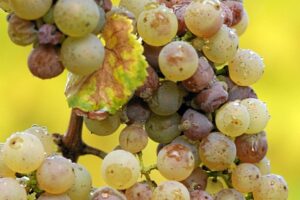
Equally imperative is when the berries become attacked by botrytis. The grapes need to be ripe before they are attacked by botrytis. Growers can tell what is taking place with the berries from the change in their color, which turns from white to pink to reddish-purple before the botrytis fully sets it.
Because white wine grapes have no anthocyanins, which are what give red wine grapes their color, it is thought that it is the botrytis process that brings about the change in the color of the grapes due to the speeding up of the ripening process brought on by the botrytis.
When the change of color has finished and the grapes are being attacked by the noble rot, the flavor and intensity are magnified in the fruit because the botrytis adds additional levels of sugar, along with glycerin and acidity, while helping concentrate additional flavors in the grapes.
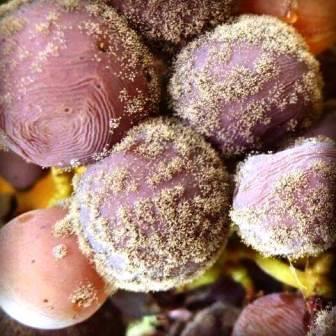
When a grape is initially struck by botrytis, also known as noble rot, the fruit is attacked through the pores and cracks in the skin of the grape by the fungus. Shortly after that, it becomes easy to see the fungus developing as it begins to appear on the skin of the grape.
At this point in time, the berry changes color, turning dark brown. Once the grape has been penetrated and covered with rot, the berry begins to lose its juice, becoming dehydrated and incredibly concentrated.
Once the process has been completed, with the help of morning mists, warm, windy afternoons, and humid conditions, the fungus dies and the berries are ready to be picked.
During this stage, the shriveled, dehydrated, concentrated grapes have developed more complex, spicy, tropical fruit, nut, floral, and incredible honeyed characteristics along with ample levels of acidity.
These qualities are sought after in Sauternes and other sweet wine-producing regions outside Bordeaux for their sugary, honey-filled, tropical fruit and exotic sensations. Of course, the wines need enough residual sugar remaining after fermentation to be considered Sauternes as well.
The amount of sugar remaining after fermentation varies in Sauternes. On average, it is between 80 to 120 grams per liter of residual sugar when bottled.
However, some high-end cuvees are over 160 grams per liter of sugar. Over the last several decades, the sugar levels in the wines of Sauternes and Barsac have increased, giving consumers richer, more concentrated, sweet wines.
In difficult vintages where the grapes were not able to reach the required level of sugar to be classified as Sauternes, Chaptalization is allowed. Chaptalization is when the winemaker adds sugar or artificially concentrated grape juice.
Another technique that can be used in poor vintages by producers is Cryoextraction. Cryoextraction subjects the grapes to temperatures below freezing levels before they are pressed, ensuring that only the juice with the highest levels of sugar and concentration are used to make the wine.
This works because, during Cryoextraction, the grapes with the highest sugar levels have a lower freezing point. During the pressing, the less sweet juice remains in the grapes, while the juice with the higher sugar levels is extracted during the process.
However, while many of the top estates own Cryoextraction machines, it is considered a technique of last resort and is almost never used.
Low yields are important to produce great sweet Bordeaux wine. This is attained by severe pruning. Without low yields, it’s difficult for noble rot to develop. Yields at the top estates in Sauternes are often between 10 to 18 hectoliters per hectare.
Growers must also remain vigilant prior to harvest and remove not only unripe grapes, but grapes that have been attacked by black rot, or berries that have attracted the interest of a myriad of different insects.
The maximum yield allowed by law in Sauternes is 25 hectoliters per hectare. However, all of the best estates are much closer to producing yields of 12 to 15 hectoliters per hectare. In vintages where the wine did not reach the level of quality desired by the chateau, the wine could be declassified.
This means that the wine was not produced and was either placed into the second wine of the chateau, or the juice was sold off in bulk to a negociant. Most recently, this took place in 2012. In 2012, several of the top chateaux in Sauternes did not produce any wine.
Sauternes is an expensive wine to produce. It takes multiple passes through the vineyards for the pickers to harvest all the grapes with enough rot on them. This is the key to the success of making great wine in Sauternes. It’s also very expensive.
The best estates often have yields of only 8 to 10 hectoliters per hectare. For the top wines that translates into the fact that each vine might only deliver a single glass of wine!
Vinification of Sauternes: Once the grapes have been picked, the winemaker decides how to press the grapes. The grapes at the top estates are pressed in whole bunches using a vertical press, which is the most gentle and slowest method available to extract the juice, as well as the most expensive.
Or they can use, for example, pneumatic presses. Fermentation at the top estates usually takes place entirely in barrels. Chateaux can also vinify in stainless steel or cement tanks.
The fermentation process is slow. It can take several months before it’s completed because of the high sugar levels. The choice of Chaptalization needs to be made if the fruit does not have the desired degree of sugar to convert to alcohol. However, that is almost never done at the best chateaux.
The reason is, while you can add sugar, you only increase the potential level of alcohol and not the addition of much-needed residual sugars.
The best properties age their wine using a healthy percentage of new, French oak barrels. The percentage of new oak barrels and the amount of time the wine is aged in barrels varies from chateaux to chateaux. Chateau d’Yquem uses 100% new French oak barrels, while many of the other great producers use closer to 50% new, French oak barrels for the aging of the wine.
While Chateau d’Yquem can age their wine in up to 36 months in barrel, most producers do not age their wine as long. On average, the wine spends 22 months or less in the barrel. The level of alcohol is important in Sauternes. If the potential level of alcohol appears too high, winemakers can stop the fermentation process by either lowering the temperature of the wine or by adding sulfur dioxide.
Dry white wine in Sauternes: Many Bordeaux wine producers in Sauternes and Barsac also produce a dry wine. For example, Chateau d’Yquem makes a dry white called Y, Rieussec also produces a dry white called R.
Numerous other Bordeaux chateaux make dry white wine from Sauternes as well. They are not highly sought after and sell for a lot less money than the sweet wines from the same estate.
Olivier Bernard, one of the co-owners of Chateau Guiraud owns Clos des Lune, an estate in Sauternes that is devoted to making only dry white wine.
By 2018, close to 160 hectares of vines (8% of the appellation) in Sauternes were devoted to producing dry, white Bordeaux wine. Those numbers continue slowly increasing as sales of Sauternes continue becoming more difficult.
Pierre Dubourdieu produced the first dry white Bordeaux wine in the appellation, Cuvée Saint Martin in 1949. At the time, Pierre Dubourdieu was in charge of his families vineyard, Chateau Doisy Daene.
Due to the AOC laws in Sauternes, dry white Bordeaux wines produced from grapes planted in the appellation are classified and sold as generic Bordeaux Blanc wine.
To qualify as a Bordeaux Blanc, grapes from the region of Sauternes are required by AOC law to contain at least 162 grams per liter of sugar after fermentation. The dry white wine of Sauternes has not fully captured the attention of consumers.
To help promote these white wines, some producers have tried to have the wines reclassified as dry white wine from the Graves appellation.
The hope and logic behind this request are due to the fact that an AOC Graves wine is more interesting to consumers than a generic Bordeaux wine, which will help the wines sell-through.
While the dry white wines from Sauternes producers sell for a lot less money than the sweet wines, they are much less costly to produce. The move to reclassify dry white wines from sweet producers is not unheard of.
The small appellation of Cerons, which produces lower-priced sweet wines was able to have their dry white wines reclassified as white Graves.
Due to its extremely high quality, Sauternes is the most famous Bordeaux appellation that produces sweet white wine. However, Sauternes only produces about 50% of all the sweet wine made in Bordeaux. In total, 13 additional appellations also allow the production of sweet Bordeaux wine.
The other regions do not make wine at the level of Sauternes, but they are considerably less money in most cases. Not much sweet wine is made in Bordeaux. In fact, when you combine all the regions allowed to produce sweet, white, Bordeaux wine, the total production is at best, only 1% of all the wine made in Bordeaux each year.
The following appellations all produce sweet, white Bordeaux wine: Bordeaux, Bordeaux Superieur, Cadillac, Cerons, Cotes de Bergerac, Graves Superieurs, Haut-Benauge, Loupiac, Monbazillac, Premieres Cotes de Bordeaux, Sainte Croix du Mont, Sainte Foy and Saint Macaire are all appellations that allow the production of sweet Bordeaux wine.
You can read full details on each of these appellations in our guide to the Lesser Known Bordeaux Appellations.
Sauternes and Barsac in the marketplace today: Over the years, the sweet, white Bordeaux wines of Sauternes have fallen from favor. This is part of the reason the production of dry, white Bordeaux wine from Sauternes has increased. Some of the loss of popularity has to do with wine lovers cutting back on calories and not wanting more wine after dinner, especially, highly caloric wines.
Generally speaking, sweet wine is not as popular as it used to be. That’s a loss for not only the wine producers but for wine lovers who enjoy Sauternes as well.
Interestingly, until the 1980s, at best, there were only one or two years per decade with enough botrytis to produce a great Sauternes. In the decade of the 1980s, 4 out of 10 years were great. The 1990s saw 3 good years, which is a return to normalcy.
But since 2000, the entire region has had the good luck of being able to make a great wine in the majority of vintages, though, a few years were severely compromised due to hail and frost, which made it impossible for some producers to make wine. To help increase revenue, some to the top estates have started selling used barrels to makers of Bourbon and various Whisky makers.
It’s not just the Chateaux at the top that are producing great wine, it’s all over the entire appellation. While there are numerous strong producers today, for my palate, Chateau Coutet, Chateau Climens, and Chateau Suduiraut. Chateau Raymond Lafon, Chateau Rieussec, and Chateau de Fargues are among the best sweet, white wines in the world! If you’re a fan, they all merit purchasing.
In 2015, Sauternes became the last major Bordeaux appellation to create its own cooperative. The cooperative, which started off with a minimum of 20 growers, will produce both sweet, white Bordeaux and dry white Bordeaux wine as well as wine used to make Cremant de Bordeaux, a sparkling wine.
The cooperative started off making wine at a few different chateaus in the Sauternes appellation. In time, they expect to build their own facilities and cellars.
AOC laws and regulations for Sauternes and Barsac. The AOC laws of Sauternes dictate that wines from the appellation need to be grown in one of the 5 specified communes, Sauternes, Barsac, Bommes, Preignac, and Fargues. Interestingly, Fargues was not always a part of Sauternes.
Fargues was added to Sauternes in 1921, which changed the landscape of the region as the commune of Cerons was pushed out. The allowable yields in Sauternes are controlled by AOC law. While the maximum yields allowed by law is 25 hectoliters per hectare, all of the best estates are much closer to yields of 12 hectoliters per hectare.
Interestingly, the wines of Barsac can be labeled as either Sauternes or Barsac. The AOC laws and rules of Sauternes also state the wines need a minimum level of 13% alcohol, the wine needs to have to come from grape musts with a minimum of 221 grams of sugar per liter. The wines must pass a blind tasting exam following bottling.