
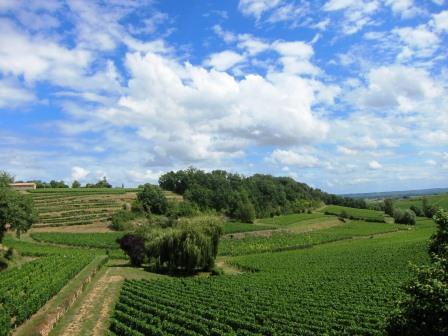
Vineyards of France
France is not only the world’s most famous wine growing country, it also takes credit for being one of the world’s oldest wine regions as well. The ancient Romans began cultivating vines in France about 125 BC. They moved into the Rhone valley not too long after that.
By the first century AD, the Romans were also active in Bordeaux. Ancient ruins and antiquities can be easily spotted all over France, especially in Bordeaux as well in the Rhone Valley. The Romans knew what to look for. They wanted to plant on hillsides with exposure to the sun and natural drainage.
Plus the vineyards could not be too far from towns and cities to allow for ease in trading. As of 2016, France is second in production of wine, at least in terms of volume all over the world. Only Spain makes more wine today. However China is catching up, in terms of volume, but not price.
Currently, over 792,000 hectares of vines are planted with the purpose of growing grapes for wine in France. This is a change in the amount of planted hectares as less than a decade ago, France had 861,000 planted hectares.
The French Governmental Agricultural board has helped force the reduction in the amount of vines planted, as several small vineyards in poor areas were not able to make money selling their grapes or wine.
Those 792,000 hectares planted in France, depending on the vintage can produce between 7 and 8 billion bottles of wine per year! Yes, that is Billions with a B! That makes France the world’s most important wine producing region in terms of volume and in dollar value.
France, Spain, Italy and America are the world’s largest producers of wine in terms of dollars and hectoliters. However, that could one day change as China is rapidly catching up in production as they are now in the top 5 producers as well. In fact, China now has more more planted hectares of vines than France.
Chinese vineyards now occupy up to 11% of the world’s plantings for grapes used to produce wine. The growth in China is massive when you consider that in 2000, they had less than 4% of the world’s vineyards. But the amount of wine and dollar value of the wine remains dwarfed by France.
In fact, at least 85 of the world’s most important wines are produced in France. France still stands above all the other wine producing countries with its massive volume of wine, and more importantly, its ability to export their wine all over the world!
However, for those of you that like to look at numbers, Spain has 1.02 Million hectares, China, 799,000 hectares, France, 792,000 hectares, Italy, 690,000 hectares and Turkey comes in at #5 with 502,000 hectares.
For years, France claimed the record for the most hectares of land, cultivated with wine grapes. That is no longer the case, at least as of 2016. Today, Interestingly, the areas with the most land planted with grapes are Spain, China, France and Australia.
This is not to be confused with volume in terms of hectoliters, number of bottles, or value, but in pure raw land, France has fallen behind, and that trend is expected to continue.
For those that like vineyards by the numbers, the largest appellation is the Languedoc with almost 2000,000 hectares of vines. The honor for the single largest vineyard belongs to San Bernabe Vineyards in Monterey California. Today it has close to a whopping 2,800 hectares of vines!
France, with its ocean of wine makes both red wine and white wine. Out of all that French wine, about 70% of it is devoted to the production of French red wine and 30% is devoted to making French white wine. While wine is produced all over France, the most important, top wine producing appellations of France are: Alsace, Beaujolais, Bordeaux, Burgundy, Champagne, Corsica, Jura, Languedoc-Roussillon, Lorie, Provence, Rhone Valley, Savoy and South West France.
The most top, most important appellation for wine production in France based on volume per vintage and dollar value is Bordeaux. In fact Bordeaux produces an average of more than 450 million bottles of wine per year!
Bordeaux produces the most wine in terms of dollar value as well as in volume and export. 90% of Bordeaux is devoted to red wine, the remaining 10% is white Bordeaux wine.
More than 60 different grape varieties are planted for the production of red wine and white wine in France. Obviously some grape varietals are more important than others due to their ability to produce complex, age worthy wines of character and distinction and of course, their popularity with consumers.
The top ten grapes with the highest concentration of planted vineyard hectares in France are:
#1 Merlot 13.6% – 116,715 hectares
#2 Grenache 11.3% – 97,171 hectares
#3 Ugni Blanc 9.7% – 83,173 hectares
#4 Syrah 8.1% – 69,891 hectares
#5 Carignan 6.9% – 59,210 hectares
#6 Cabernet Sauvignon 6.7% – 57,913 hectares
#7 Chardonnay 5.1% – 35,252 hectares
#8 Cabernet Franc 4.4% – 37,508 hectares
#9 Gamay 3.7% – 31,771 hectares
#10 Pinot Noir 3.4% – 29,576 hectares
While almost all French wines are blends of more than one grape varietal, that is not always the case. In Burgundy, only Pinot Noir is used to produce red Burgundy wines. Chardonnay is the only allowable grape used in the production of white Burgundy wine in Burgundy.
In Bordeaux, the vast majority of red wines are blends. However, in St. Emilion and Pomerol, some of the most famous producers make wine from 100% Merlot. Almost all white Bordeaux wines are blends. But that is not always the case. There are a few chateau in Pessac Leognan for example that produce wine from 100% Sauvignon Blanc.
In Sauternes, some estates produce wine using 100% Semillon. The choice of blending or not depends on the rules and laws of the appellation, the terroir and the vision of the winemaker.
The type of wine and the choice to blend or not starts with the terroir, soil and grape varieties planted in the vineyards. Much of where the fruit was planted has an impact, (soils, terroir, weather) on the quality, character and style of wine.
Further impacting what nature provided are the choices made by the vineyard managers during the growing season and harvest, coupled with decisions the winemaker will need to make in the cellars. All those factors are part of determining the quality, style and character of the wine.
Terroir is more of a concept than a specifically identifiable trait. Terroir encompasses a myriad of important natural conditions including: the soil, altitude, elevation, exposure to the sun, temperature ranges, access to water, trees, types of rock on top of the soil as well as in the soil and microclimate for each appellation or vineyard. For a detailed explanation of the terroir in Bordeaux; Bordeaux Terroir and Soil
This is important because when vines are placed in close proximity to other vines, they naturally compete for food sources.
The underlying logic is that closely planted vines have to compete with each other for life giving water and nutrients. This competition forces the plant roots to delve deeper into the soils, which helps the plants sustain life in dry periods and produces lower yields and smaller, but more concentrated grapes.
The majority of well managed vineyards in gravelly terroir are planted to a standard 10,000 vines per hectare. That means that in each row, the vines are placed 1 meter apart. In the Right Bank, and other terroirs with more clay and limestone, the planting density is less, with averages of 6,5000 vines per hectare to 7,500 vines per hectare.
However, there are exceptions to every rule. For example, Chateau Ausone has some plantings at 14,000 vines per hectare and Jean Philippe Janoueix, with his Croix Mouton 20 Mille vineyards has plantings of 20,000 vines per hectare.
The record for the highest level of vineyard planting density belongs to Dominique Leandre Chevalier in the Cotes de Blaye appellation. They have a 3 hectare parcel of vines that is planted to a whopping 33,000 vines per hectare! Domaine Leandre Chevalier produces several wines blending in portions of their high density plantings, but “Tricolore” is the only wine made using 100% Petit Verdot from a vine density of 33,000 vines per hectare.
Climate is of course one of the key factors in the character and style of wine a vineyard can produce. Terroir or soil alone does not make a quality wine. The wine making decisions of the grower and wine maker can have an equal impact on the wine. If that was not the case, how do you explain two completely different expressions of wine produced from the same vineyard?
The uniqueness of terroir in part, gave birth to the often cumbersome French system of classifying their numerous wines, countless regions, appellations and of course the AOC system.
The most famous classification of French wine took place in 1855, the year of the original Bordeaux wine classification of the Medoc. The 1855 classification only takes into consideration 61 different chateaux from the Medoc and Haut Brion from Pessac Leognan. The wines classed according to their price and quality in five different classes; First Growth, Second Growth, Third Growth, Fourth Growth and Fifth Growth.
The sweet, white Bordeaux wine of Sauternes were also classified in 1855. St. Emilion was first classified in 1955. That classification is redone every 10 years. The most recent classification for St. Emilion took place in 2012. Current St. Emilion Classification This was followed by the classification of Graves, which took place in 1959. To learn more about Bordeaux along with facts and figures of its production: Production Facts, Figures for Bordeaux But what about the rest of the wine producing regions of France?
In 1935, the INAO, Institut National des Appellations d’Origine defined strict, specific, appellation characteristics to help guide the consumer, promote minimum levels of quality and energize growers into producing better wines. The AOC system. Appellation d’Origine Controlee. The purpose of the AOC system, which is used for food and other European agricultural products makes good sense.
The thought being that it is the specific place where the product is produced that gives the wine or product its unique character and style. Today, as of 2016, the Bordeaux wine growing region encompasses 60 different appellations in total: The Bordeaux Appellations Guide
Aside from creating the appellation system, in 1935, the INAO also wrote a series of French Laws and gave birth to the original four main categories, or classes of French wine which many of us are familiar with today. Subsequently, these categories were modernized, but we will get to that in a moment. These are the four original categories or classes of French wine:
Vin de Table – Wines with this designation are listed as being from France and provide the producers name on the label. Vin de Table, or Table wine are made from any vineyard or grape varietal in France. Wine sold as Vin de Table do not by law, list grape varietals, vintage, regions, appellations or production techniques on the label. There are no restrictions on the grapes, vineyard management or production techniques used to produce Vin de Table wine.
Vins Sans Indication Geographique – VSIG is the new classification for Vin de Table wines. VISG wines are allowed to use the name of the country. but not the specific grape variety, year, appellation or region on the label of Vins Sans Indication Geographique classified wines.
Vin de Pays – VDP – Wines using the Vin de Pays designation were produced from a specific, major, wine growing region, they also state the producers name and France. Vin de Pays allows more information to be placed on the label including the area the wine was produced in. There are very few restrictions in the production of wines sold as Vin de Pays.
Vin Delimite de Qualite Superieure – VDQS is seldom encountered today. Less than 1% of all French wines bear the VDQS designation on the label. Vin Delimité de Qualite Superieure is similar, but less restrictive in its rules and regulations for the grape varieties, terroir and production techniques than the more commonly seen AOC classification. VDQS wines are seen as being produced from a recognized area that has not yet been approved as an appellation by the AOC.
Appellation d’Origine Controlee – AOC, accounts for 53.4% of all wines from France. Currently, more than 450 separate and potentially distinct AOC’s in France are in use today.
There are a series of rules and regulations that go along with being classified as an AOC wine. This includes restrictions as to the specific geological area where the fruit is grown and the wine was made; along with the type of allowable grape variety planted in the vineyard.
There are also specific, agreed upon production methods, minimum levels of alcohol and maximum levels of yields, vine age and required minimum vineyard planting densities. There are also rules for harvesting and vinification techniques in place along with restrictions on where the cellars must be located.
In some cases, exemptions are granted in the case of cellar locations and on occasion some of the other rules. However, it is important to note that every quality grower produces wine from lower yields and higher levels of alcohol than is the minimum standard allowed by AOC law. In fact, most of the standards required for the Appellation d’Origine Controlee classification are surpassed by every serious wine producer.
Beyond the classification of the appellations and vineyards, depending on the specific appellation or AOC, vineyards and chateaux can also be classified. The most famous of these classifications is the 1855 Classification of the Medoc that we discussed earlier. Burgundy has its own vineyard classification system as does St. Emilion.
While Bordeaux is the most heavily classified, wine producing region in France, it is not the only appellation to classify their wines. Burgundy is the second most, wine producing, classified region in France. Fortunately for Burgundy wine lovers, the classification is reasonably simple to understand.
Understanding the Classification of Burgundy Vineyards
The main ideal that differentiates the classifications of Burgundy from that of Bordeaux is that in Bordeaux, with the exception of St. Emilion, it is the chateau or producer that is classified. In Burgundy they classify the terroir.
Grand Cru is the top classified status in Burgundy. Not many vineyards are eligible for Grand Cru status. To give you an idea, about 2% of the Burgundy regions vineyards are classified as Grand Cru. On the label, only the vineyard and classified status is listed. Grand Cru wines are produced from the lowest yields of all classified Burgundy wines.
Premier Cru is the next highest level of classified status for Burgundy wines. Close to 12% of all Burgundy vineyards are classified with Premier Cru status. Premier Cru classified wines provide the name of the village first, and then the vineyard on the label. If the wine is produced from multiple vineyards from the same village, only the vineyard name will appear on the label.
Village wines, the next level of classification in Burgundy list the appellation when they are produced from multiple villages. This is quite common as many of these wines are produced from a myriad of villages and vineyards. For wines produced from one village and vineyard, that information is placed clearly on the label.
Regional wines are the lowest level of classification in the Burgundy system. The wines are not produced under the same rules and conditions as the higher levels of classified Burgundy wines.
Chablis, even though the appellation is located in Burgundy has its own unique system of classification or its wines. Generally speaking, the Chablis classification is quite close to what is established in Burgundy. However there are a few differences. Chablis has 4 levels of classified status: Grand Cru, Premier Cru, Village Chablis and Petit Chablis.
Beaujolais has their own system of classification, even though they are also in Burgundy. The wines of Beaujolais have the following different levels of classification: Beaujolais AOC/AOP, Beaujolais Villages and Beaujolais Cru.
Champagne has its own, unique system of classification. Interestingly, the classification of Champagne takes the level of quality of the grapes into consideration, along with the terroir and soil. In Champagne the best wines are classified as Grand Cru Champagne, followed by Premier Cru Champagne.
Alsace wines are classified as well. The wines of Alsace have two levels of classification, Grand Cru and Alsace AOC/AOP.
It’s not just the French that like to classify things. Most, if not all of Europe enjoy classifications. It took long enough, but a new system for the classification of wines from France was created in 2012 to replace the previous, antiquated, classification.
The 2012 classification system is much more simple. It relies on three levels of basic classification instead of four. Plus more information is available to the consumer on the new labels attached to wine bottles as allowable by law. However, it should be noted that due to competition on the marketplace, the recent 2012 classification has been amended as you will see below.
The new categories are of classification in France are:
Vin de France – This new classification, which replaces Vin de Table, allows the consumer to know much more information about the wine. Wines with the Vin de France designation sport wine labels that include the type of grape variety used to produce the wine and the specific vintage.
To be able to include the vintage and grapes in the wine, the producer must notify the governing body of its intention in advance of the bottling.
However, other than the country of France, no information is allowed as to where the grapes are from. It’s important to note that there are some Vin de France wines that can be quite good, and also quite expensive.
That is because some wines are forced to use the Vin de France classification because the owners or winemakers violated their appellation law. As an example, they included grapes not allowed in the region, or the vineyard management techniques did not conform to specific AOC regulations.
Indication Geographique Protegee – IGP will be used instead of Vin de Pays. IGP wines offer growers and producers a myriad of choices as there are no restrictions on grape varieties. Estates are also allowed to blend grapes or wine from multiple appellations.
Appellation d’Origine Protegee – AOP is intended to replace the previously important AOC classification, Appellation d’Origine Controlee. Not much else has changed in this classification, other than the name.
Organic and Biodynamic wines are now certified. To be a producer with the ability to place the words organic on your label, for a minimum of a three year period, the wine maker must use only organic farming techniques.
Certification be granted from any of the following agencies which are regulated by the French Ministry of Agriculture: Ecocert, Qualite France, ULSAE, Agrocert, Certipaq and ACLAVE.
Estates with the right to place the word Organic on their label have two possibilities. Once they are certified as Agriculture Biologique, they can use a logo from either the EU or the official Organic label.
Biodynamic Certification is granted to estates that for a minimum of a three period farm their vineyards utilizing the techniques created by Rudolf Steiner. The same bodies that certify organic producers also certify Biodynamic estates: Ecocert, Qualite France, ULSAE, Agrocert, Certipaq and ACLAVE.
An additional or different certification is available, Demeter. Demeter certification is given to estates making wine from biodynamically certified fruit that was produced under the rule and regulations of the Demeter group.
Producers with SIVCBD; Biodyvin on their label are members of The Syndicat International des Vignerons en Culture Bio-Dynamique association.