
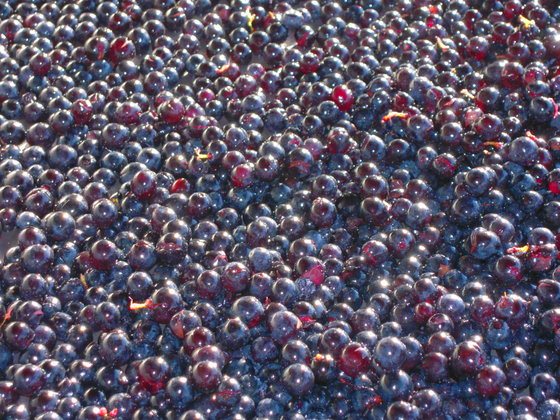
Petit Verdot Wine Grapes
Petit Verdot first gained fame as a blending grape for making Bordeaux wine. However, because Petit Verdot often has difficulties reaching full phenolic ripeness, not much of it is planted or used in Bordeaux today. Yet, that was not always the case.
In fact, Petit Verdot, which takes its name from the small size of its berries, was one of the more important grapes for many Bordeaux chateaux in the Medoc during the 1700s. However, quite a bit of Petit Verdot in The Left Bank was removed after the devastating attack of phylloxera in the late 1800s.
What little Petit Verdot remained was once again removed from the vineyards in Bordeaux following the frost of 1956. Petit Verdot began to reappear in California in the mid-1970s. Most of those vines came from older plantings placed in vineyards located in the Mt. Veeder appellation.
The exact origins of Petit Verdot are unclear. But it’s possible the grape was created from a cross of Duras and Tressot. It is thought that the grape is one of the first varieties originally planted in Bordeaux by the ancient Romans. Initially, the first plantings of the grape took place in the southern region of Bordeaux, in the Haut Medoc, closer to the Gironde estuary. Gradually, the grape began making apparencies in vineyards located in the northern part of the Medoc.
Today, Petit Verdot is more popular in the Medoc than across the river. The better examples of Petit Verdot are the few, remaining old vines, planted before 1956 and in the vineyards planting the varietal, using massale selection. Not much of the grape is planted in the Right Bank.
It seems to do best in the warm, well-drained, gravel-based soils found in the Left Bank. Interestingly, Petit Verdot has a unique characteristic not found in most grape varieties. Petit Verdot produces more than two clusters per shoot. The grape is much older than Cabernet Sauvignon.
The Petit Verdot berries need very specific conditions to ripen, starting with the correct weather during the flowering period. If the weather does not cooperate in the spring, the fruit will not ripen well, displaying green flavor and color.
Petit Verdot enjoys cooler temperatures than many Bordeaux varietals. Petit Verdot is very sensitive to water stress and ripens later than the other main Bordeaux grapes. This lateness in ripening and harvesting dates often precludes the fruit from being included in the final blend for most producers.
When Petit Verdot is added to the blend, due to its thick skins and natural acidity, it helps bring additional tannins, color, and freshness, along with a spicy character. Petit Verdot is most often harvested in Bordeaux after the Merlot has been picked and just before the Cabernet Sauvignon is harvested.
Petit Verdot is not always used in the final blends, due to issues with achieving ripeness.
However, when it is part of the assemblage, it adds additional tannin, color, and a unique flavor profile that can manifest itself with aromas of flowers, olives, or when very ripe, blueberry characteristics. When not fully ripe, Petit Verdot tends to be a sharply acidic, unpleasant grape for wine.
Petit Verdot is a hardy grape with a lot of tannins. That makes Petit Verdot in wine and food pairings a natural fit for rich, meat dishes, grilled steak, spicy pork, veal, lamb, all types of game, and sausage. Spicy foods pair well with Petit Verdot and it’s perfect for a myriad of different hard and semi-soft cheeses.
In Bordeaux, 99% of the time, Petit Verdot is used as a blending grape, especially in the Medoc. Chateau Pichon Lalande in Pauillac has some of the largest plantings of Petit Verdot in the Medoc.
Chateau Palmer in Margaux, and Chateau Lagrange in St. Julien are also known for including a large percentage of Petit Verdot in their vineyards. The percentage used in the blends varies depending on the berries ability to fully ripen, which is not always easy in Bordeaux.
Chateau Fonbel in St. Emilion could have the largest amount of fruit planted in the Right Bank at close to 10%. Chateau La Lagune might have the most Petit Verdot of any 1855 Classified wine in modern times as 10% of their vineyard is devoted to the variety. Chateau Belle-Vue in the Haut Medoc appellation has 20% of the vines dedicated to Petit Verdot.
However, the largest plantings of Petit Verdot in Bordeaux today are probably located at Chateau Bolaire in the Bordeaux Superieur region. In some vintages, as much as 40% of their blend is Petit Verdot.
Interestingly, there are a few small producers in Bordeaux making wines from 100% Petit Verdot! Chateau Belle-Vue (Haut Medoc) was the first estate to start producing a small amount of wine from 100% Petit Verdot called Le Petit Verdot.
The most famous estate is located in the Haut Medoc, Chateau Malescasse, which makes Le Petit de Malescasse, a 100% Petit Verdot that comes from a small 1.27-hectare parcel of vines. In the Medoc, Chateau Lousteauneuf produces a 100% Petit Verdot aged entirely in Amphora. Also located in the Medoc, Chateau La Tour de By makes Cuvee Petit Verdot, which is a 50-case production. In 2018, a tiny amount of Hommage Denis Dubourdieu Petit Verdot was produced from AOC Bordeaux.
You also find 100% Petit Verdot wines from the Margaux appellation from Chateau Moutte Blanc Moisin. Other producers include Chateau Maine Gazin, Chateau d’Osmond, Chateau Madran Cuvee Excellente and Chateau Mirambeau Papin are all Bordeaux Superieur wines produced solely from Petit Verdot grapes.
In Pessac Leognan, Vignobles Andre Lurton makes Noroit Petit Verdot from old vines that are close to 100 years of age. Chateau Massereau produces Eliott, a 50 case Cuvee made from 100% Petit Verdot planted in Graves.
Dominique Leandre Chevalier in the Cotes de Blaye appellation produces Tricolore, which is made from 100% Petit Verdot that is planted with a vine density of 33,000 vines per hectare. The vines are all ungrafted, pre-phylloxera. The wine is sold as a Vin de France.
It should be noted that while 100% Petit Verdot Bordeaux wines are interesting to taste, as there are not a lot of them, they are not that interesting. While dark in color and aromatic, they lack complexity. The grape is better when used as part of the blend.
Petit Verdot is grown in several other countries other than France. Argentina, Australia, Chile, Italy, Portugal, and Spain all have vineyards planted to Petit Verdot. The grape has been shown to produce high-quality wines in America as well where it has been used as a blending varietal and for wines made from 100% Petit Verdot.
In America, California and Washington State are the most popular areas making wines from 100% Petit Verdot. Hendry Ranch in the Napa Valley is one of the better Petit Verdot producers from California.
Pahlmeyer, a top producer in Napa Valley also makes wine from 100% Petit Verdot. Jean Hoefliger the winemaker at several Napa estates including Alpha Omega is now producing a 100% Petit Verdot called “Decades 5” from vines planted in the Stagecoach Vineyard.