
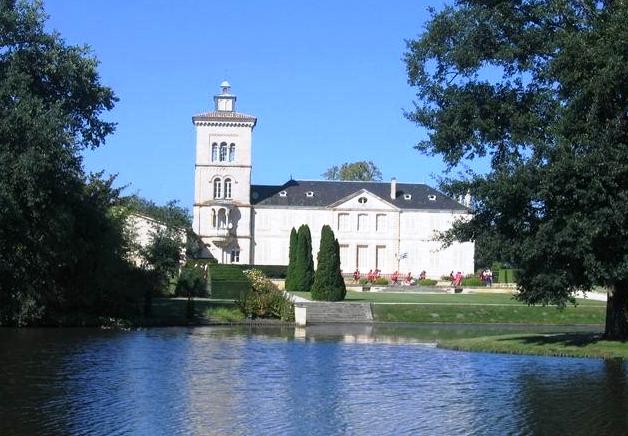
Learn everything about Chateau Lagrange St. Julien, Third Growth, with wine tasting notes and wine with food pairing tip. Learn the best vintages, a history of the property, information on vineyards and winemaking. If you want to read about other important, Bordeaux Chateaux: Links to all Bordeaux Wine Producer Profiles
Chateau Lagrange History, Overview
Chateau Lagrange started out life as Maison Noble de Lagrange Monteil as far back as the middle ages. Historical documents mention the vineyard as far back as 1631. During the 18th century, the picturesque estate was the property of Baron de Brane.
The Baron was better known for counting among his holdings, Brane Cantenac and Brane Mouton, which we are more familiar with as Chateau Mouton Rothschild today. When the Baron was in charge of the estate, the wines were sold as Baron St. Julien.
Like most Bordeaux vineyards, the property passed through numerous hands. For a time, it belonged to John Lewis Brown who owned Chateau Cantenac Brown in Margaux, as well as Chateau Brown in Pessac Leognan.
However, Chateau Lagrange did not become well-known for producing wine until 1842. That is when the owner, Count Duchatel added a drainage system in the vineyard. This helped improve the wine immensely. While drainage in vineyards is commonplace today, that was very forward-thinking in 1842.
Deep in debt, the owners began breaking up the estate, selling portions of their vineyard to survive. The first major sale took place in 1840. Those sales caused Chateau Lagrange to downsize from its massive 280 hectares to a manageable 157 hectares. That sale would not be the last time Chateau Lagrange reduced their Medoc vineyards.
In 1970, 32 hectares were sold to Chateau Ducru Beaucaillou. Other parcels were sold to Henri Martin for use in Chateau Gloria. By 1983, the remaining holdings of Lagrange were purchased by the large, Japanese company, Suntory from the Cendoya family, who had owned Chateau Lagrange since 1925.
Chateau Lagrange the Modern Age
The sale was a good decision for the Left Bank chateau. Suntory brought the funds needed to renovate the wine-making facilities and replant the vineyards.
Once the new owners took over the property, they spent massive sums of money to modernize the wine-making facilities and replant the vineyards. They had no choice as the buildings were dilapidated and of the vineyard was in dire need of replanting.
Under the direction of Marcel Ducasse, the director of Chateau Lagrange from 1993 to 2007, the vineyard expanded from 48 planted hectares to 138 planted hectares. The vine density was also increased as more than 100,000 new vines were added to the vineyard. In 1985, the new owners also began producing a second wine, Les Fief de Lagrange.
Chateau Lagrange made numerous improvements in 2008 and underwent extensive renovations again that included modernizing their entire wine-making facilities and cellars in 2013. All the effort and investment expended by Suntory has allowed Chateau Lagrange to produce a much better wine.
Chateau Lagrange Vineyards, Terroir, Grapes, Winemaking
The massive 182-hectare estate of Chateau Lagrange has 118 hectares under vine. The vineyard is planted to 66% Cabernet Sauvignon, 27% Merlot, and 7% Petit Verdot. The Petit Verdot was added to the vineyards in 1988. Over the years, the vineyard has continued to increase its percentage of Cabernet Sauvignon.
The vineyard is one massive block of vines that can be divided into 102 different parcels. However, the easiest way to think of Chateau Lagrange is by knowing all their vines are dispersed over 2, gently sloping, gravel hillsides.
The slopes are well placed in the west of the Saint Julien appellation, close to Chateau Gruaud Larose and Chateau Branaire Ducru. At the peak of their vineyards, the hillsides reach up to 24 meters, which puts their vines at the highest elevation in the entire Saint Julien appellation.
Today, the average age of the vines is more than 35 years of age. The terroir is gravel, sand and clay soils. There are also parcels with deposits of iron. The vineyard is planted to a vine density of 8,500 vines per hectare. They use optical sorting technology during the harvest.
Chateau Lagrange Winemaking
To produce the wine of Chateau Lagrange, vinification takes place temperature-controlled, stainless steel vats that range in size. The 98 vats range in size allowing for parcel by parcel vinification. The smallest vats are 66 hectoliters with the largest vats coming in at 220 hectoliters.
The grapes are vinified using co-inoculation. The selection of the press wine is performed by adding it on a vat by vat basis. The wine is aged in 60% new, French oak barrels for up to 21 months before bottling.
White Wine of Chateau Lagrange
Additionally, Chateau Lagrange is one of the few Medoc properties to produce a white Bordeaux wine. They have 7 hectares of vines used for planting white Bordeaux wine grapes. Those 7 hectares are planted to 60% Sauvignon Blanc, 20% Semillon and 20% Sauvignon Gris. They removed all of their Muscadelle vines. The white wine of Lagrange, which began production in 1996 is sold under the name of Les Arums de Lagrange.
On average, all together, Chateau Lagrange produces almost 60,000 cases of wine per year. There is a second wine, Les Fief de Lagrange which made its debut in 1985.
In 2012, the estate added a new wine to their portfolio from vines located in the Haut Medoc appellation. Produced from an 18-hectare vineyard they recently purchased in the Haut Medoc appellation, the wine is sold under the aptly descriptive name of Haut Medoc de Lagrange.
The best vintages of Chateau Lagrange are: 2022, 2021, 2020, 2019, 2018, 2017, 2016, 2015, 2010, 2009, 2006, 2005 and 2000. Perhaps, because of its large size, which gives it various types of terroir, Chateau Lagrange is not always consistent. It is a wine to look for in the top years. All that being said, starting with the 2016 vintage, Chateau Lagrange make huge improvements in their wine, making the best wines in the history of the estate!
When to Drink Chateau Lagrange, Anticipated Maturity, Decanting Time
Chateau Lagrange is not a wine that is fun to drink on the young side. The wine is too powerful and tannic in its youth. Young vintages can be decanted for an average of 2-3 hours, give or take. This allows the wine to soften and open its perfume. Older vintages might need very little decanting, just enough to remove the sediment.
Chateau Lagrange is usually better with at least 8-10 years of bottle age. Of course, that can vary slightly, depending on the vintage character. Chateau Lagrange offers its best drinking and should reach peak maturity between 10-25 years of age after the vintage.
Serving Chateau Lagrange with Wine, Food, Pairing Tips
Chateau Lagrange is best served at 15.5 degrees Celsius, 60 degrees Fahrenheit. The cool, almost cellar temperature gives the wine more freshness and lift.
Chateau Lagrange is best served with all types of classic meat dishes, veal, pork, beef, lamb, duck, game, roast chicken, roasted, braised, and grilled dishes. Chateau Lagrange is a perfect match with Asian dishes, hearty fish courses like tuna, salmon, mushrooms, and pasta as well as cheese.
Château Lagrange (St. Julien) Wine Tasting Notes
32 Vintages 288,485 Views Sort by Vintage-Rating
|
2022
Château Lagrange (St. Julien) (St. Julien)
Deep in color, the nose reminds you of walking into a flower shop carrying a basket of fresh-picked berries. The wine is silky, fresh, polished, elegant, and deep, with length, soft tannins, and waves of fruit and freshness in the finish. Starting with the 2016 vintage, Lagrange has been on a hot streak and with 2022, the streak continues! The wine is produced from 86% Cabernet Sauvignon, 12% Merlot and 2% Petit Verdot. Drink from 2027-2055. 94-96 Pts. 3,205 Views Tasted May 8, 2023 |
|
2021
Château Lagrange (St. Julien) (St. Julien)
The nose, with its tobacco, herbs, flowers, red currants, cedar and spice pops with little effort. On the palate, the wine is medium-bodied, crisp, chewy and loaded with savory-tinted red fruits with ample, sweetness to the soft, supple, cherries in the finish. The wine is a blend of 84% Cabernet Sauvignon, 14% Merlot and 2% Petit Verdot. It is interesting to note that this is the highest percentage of Cabernet used in the blend in the history of the estate. Drink from 2025-2045. 420 Views Tasted Mar 9, 2024Blackberries, cedar, tobacco, spice and savory herbs on the nose bring you to a soft-textured, supple, round, forward, classical wine with a creamy-textured, dusty, peppery, crunchy, red currant-packed finish. The wine is a blend of 84% Cabernet Sauvignon and 16% Merlot. It is interesting to note that this is the highest percentage of Cabernet used in the blend in the history of the estate. 13% ABV. Yields were low at only 30 hectoliters per hectare. Drink from 2025-2045. 91-93 2,250 Views Tasted May 20, 2022 |
|
2021
Château Lagrange (St. Julien) Les Arums de Lagrange (Bordeaux)
Flowers, white peaches, tangerine and yellow citrus notes with a deft touch of honeysuckle is fresh, vibrant, crisp and also creamy in the finish. Drink from 2023-2032. 90-90 1,507 Views Tasted May 20, 2022 |
|
2020
Château Lagrange (St. Julien) (St. Julien)
The perfume kicks off with mint, cigar box, black and red currants, black cherries and tobacco leaves. And with all that, the wine is just getting started because it is even better on the palate with its multiple-layers of supple, fresh, vibrant, sweet, ripe fruits, elegant silky tannins, length and purity. Starting with the 2016 vintage, Lagrange has been on a hot streak and 2020 could be their best vintage yet. If you haven't tasted what they are doing, you need to grab a bottle and pull a cork! Drink from 2027-2055. 4,033 Views Tasted Mar 21, 2023Dark garnet in color, the nose, with its tobacco leaf, cedar, cigar box, forest leaf, flowers and cassis is enthralling. Full-bodied, concentrated, big, juicy and fruity, there is a lot of life here. The fruits are ripe, creamy, spicy, long and vibrant and they not only work on the mid-palate, they carry through to the extended finish. Starting with the 2018 vintage, Lagrange has been on a hot streak. 93-95 Pts 3,649 Views Tasted May 20, 2021 |
|
2019
Château Lagrange (St. Julien) (St. Julien)
Medium-bodied, elegant and fresh, this is fabulous from the get go. The nose, with its display of cigar box, black currants and cedar is just great and the wine is even better on the palate with its display of soft-textured, vibrant, sweet, red fruits which show off their purity and freshness with ease. This is another gem showing much better in the bottle than it did in the barrel. They have really been on a roll here at Lagrange since 2015 and 2019 could be their best vintage yet! Drink from 2028-2055. 4,654 Views Tasted Mar 29, 2022A big, juicy, energetic blast of spicy, invigorating cassis is the first thing that sticks with you. The fruit is sweet, round, full-bodied and fresh. The fruit here really lingers on your palate, and the tannins are ripe and present, which is a good thing because that sensation of purity in the finish is something you want to hang on to. 92-94 Pts 7,324 Views Tasted Jun 8, 2020 |
|
2018
Château Lagrange (St. Julien) (St. Julien)
Deep in color, the wine wastes little time strutting its stuff. The spicy, fresh, vibrant red berries, cigar box, tobacco leaf and cedar grab your attention. When the wine hits your palate with all its layers of juicy, sweet, energetic fruits, things really get going, ending with a finish that is lush, round, supple, fresh and lively. As I wrote during the barrel tastings, this is the finest vintage of Chateau Lagrange ever produced! As this ages and develops more softness and nuances, the wine could score even higher. 4,904 Views Tasted Mar 9, 2021It is great to see Lagrange on a hot streak. The wine is full-bodied, round, ripe and loaded with tobacco, black currant, herbs, leaf, espresso, boysenberry and floral aromatics. With its concentration and depth of flavor 2018 is -- without a doubt --the best wine ever produced here. The wine will age for decades with ease. 93-95 Pts 5,341 Views Tasted Apr 19, 2019 |
|
2017
Château Lagrange (St. Julien) (St. Julien)
Medium-bodied, classically styled with an herbal edge to the cassis and cranberry notes found here. The wine has dusty tannins and a sharp, sweet and tart finish. 5,209 Views Tasted May 14, 2020Energetic, bright, medium bodied with tobacco and cedar-wrapped red fruits, the wine is tannic with quite a bit of freshness and a crunchy, illuminated finish. 2,752 Views Tasted Apr 26, 2018 |
|
2016
Château Lagrange (St. Julien) (St. Julien)
This just keeps getting better and better. Now you find, flowers, tobacco, earth, herbs and layers of ripe, sweet, juicy, lively red fruits. There is concentration and depth of flavor, this is without doubt, the best wine ever produced here. This will age for decades with ease. 7,637 Views Tasted Sep 21, 2019Clearly the best and most exciting wine ever produced here, the wine offers a serious depth of flavor, loads of freshness and a soft, elegant, yet, full-bodied and concentrated mouthfilling tasting experience. This will age for decades with ease. 6,459 Views Tasted Feb 9, 2019Tobacco, cedar, red currants and smokey earth notes create the character. Full bodied, fresh, clean and classic, the wine serves up a concentrated, elegant mouth full of deep, dark, red fruits with freshness. Give this at least a decade before popping a cork. 7,740 Views Tasted May 13, 2018A Truman Capote In Cold Blood kind of red, Zoe Saldana rolling the tobacco leaf, a bowl of dark red fruits with a few perfect stems of crunchy black currants. There is a freshness to the fruit and ripeness to the tannins that make this vintage a celebrity. The wine has crunch and zest and the finish offers a nice bite of tang and temptation. The wine was made from blending 70% Cabernet Sauvignon, 24% Merlot, 6% Petit Verdot. 8,021 Views Tasted Apr 29, 2017 |
|
2016
Château Lagrange (St. Julien) Les Arums de Lagrange (Bordeaux)
Forward, easy-drinking, lighter style with a simple, yellow citrus and floral, fresh profile and grapefruit filled finish that is ready to go. 1,709 Views Tasted Aug 17, 2020 |
|
2015
Château Lagrange (St. Julien) (St. Julien)
I love seeing wines continue going up in score. This vintage of Lagrange keeps getting better and better with every tasting. Now, you find a wine with depth, roundness, lift, concentration, and complexity. The fruit comes in layers with its sweet currants, edged with tobacco leaf and spice on the nose and on the elegant, silky, and fresh palate. This is showing great today, and should only get better from here. Drink from 2023-2050. 3,856 Views Tasted Dec 7, 2023This is a great vintage for Lagrange, as it allowed the fruit to develop to its true potential. There is a true depth of flavor, softness to the wall of tannins, and a fresh, vibrancy to the layers of ripe, crisp red berries that stands out in the glass. This will age for years. 4,617 Views Tasted Mar 12, 2018Deep ruby in color, this full-bodied wine is packed with crisp, crunchy cassis and black fruits. The tannins are present but ripe and the fruit has freshness and persistence in a slightly stoic but creamy finish. Only 35% of the harvest was placed into the Grand Vin. This wine was produced from a blend of 75% Cabernet Sauvignon, 17% Merlot and 8% Petit Verdot, reaching 13.3% ABV. 90 - 92 Pts 4,614 Views Tasted Apr 20, 2016 |
|
2014
Château Lagrange (St. Julien) (St. Julien)
Fresh, bright and crisp, the cassis and cranberry fruits are made more interesting with the addition of fresh herbs, tobacco and spice. Medium/full bodied, and on the fresh side, this should age nicely. 3,665 Views Tasted Feb 2, 2017With more softness than expected, this medium-bodied wine tastes like you’re biting into a handful of fresh, juicy, ripe, crisp, red fruits with a spray of cassis on top. 88-90 Pts 3,689 Views Tasted Apr 16, 2015 |
|
2013
Château Lagrange (St. Julien) (St. Julien)
Medium bodied, with light, bright, crisp red cherries and cranberry, this light, classically styled wine ends with a touch of cedar and peppery, sweet and tart red berries in the finish. 1,718 Views Tasted Feb 9, 2016Light, bright and spicy, this wine is dominated by cherry and fresh strawberry and will be best in its youth. The wine was made from a blend of 75% Cabernet Sauvignon, 21% Merlot and 4% Petit Verdot. 86-88 Pts 1,906 Views Tasted Apr 20, 2014 |
|
2012
Château Lagrange (St. Julien) (St. Julien)
Slightly strict, with a classic lean, the crisp, crunchy fruits and tannins should come together and could develop into a softer, more nuanced wine with a few years of age. 4,743 Views Tasted Mar 11, 2015Using 67% Cabernet Sauvignon, 30% Merlot and 3% Petit Verdot, the wine reached 13.5 ABV. The wine was produced from the lowest yields in the history of the estate at 38 hectoliters per hectare. Only 35% of the harvest was used in the grand vin. Spicy blackberries, cedar and cassis notes end with a tannic, crisp, medium-bodied, cassis filled finish. 89-91 Pts 3,512 Views Tasted Apr 23, 2013 |
|
2011
Château Lagrange (St. Julien) (St. Julien)
The earthy, cranberry, tobacco and cassis perfume pairs with smoky, dark, red berries, herbs and spice in the finish. 2,876 Views Tasted Feb 16, 2014Cassis, cedar, earth and vanilla scents with medium body and round tannins. Soft ripe, cherries are found in finish. 89-91 Pts 3,463 Views Tasted Apr 13, 2012 |
|
2010
Château Lagrange (St. Julien) (St. Julien)
Fresh, crisp, bright, and chewy, the red fruits offer purity, refinement, and lift, with energy, and length. Still youthful, its best days are in the future. So, hands off for a few years. Drink from 2025-2050. 4,275 Views Tasted Jan 1, 2023Continuing to develop incely, the showy nose is filled with oak, cassis, spicy, fresh blackberries and thyme. The finish tannic, but the tannins are ripe. The blend of 75% Cabernet and 25% Merlot demands at least another decade in the cellar. 7,317 Views Tasted Nov 11, 2014Soft blackberry, olive, herb, cocoa, oak and black plums open to a fresh, full bodied wine. From a blend of 75% Cabernet Sauvignon and 25% Merlot, there is some drying sensations in the fresh, crisp, red and black fruit, olive tapenade finish. 6,594 Views Tasted Feb 8, 2013Lagrange is a powerful Bordeaux wine, packed with ripe dark berries and cassis. This concentrated coca and ripe berry flavored St. Julien wine offers freshness and a licorice cassis filled finish. 90-92 Pts 6,770 Views Tasted Apr 20, 2011 |
|
2009
Château Lagrange (St. Julien) (St. Julien)
A nice juicy mouthful of sweet, ripe, round textured cassis, made even better by all the cedar, spice, espresso, flowers, and blackberries. Full-bodied, with soft, ripe tannins, and plenty of fruit in the mid-palate and finish, this has upped its game over the past few years. Drink from 2023-2045. 4,220 Views Tasted Dec 18, 2022Medium/full-bodied, crisp and classic, with a bright red berry edge to the smoke, tobacco, spice and forest leaf character, give this another 5 years in the cellar to soften and fill out. 5,222 Views Tasted Sep 20, 2019Oak, licorice, smoky blackberries and cocoa aromas lead to a medium bodied, soft, sweet, round wine with potential. The wine is much better served at close to cellar temperature. The wine was made from a blend of 73% Cabernet Sauvignon and 27% Merlot. 7,861 Views Tasted Nov 11, 2014Smoke, black pepper, ripe black cherry, earth and plum notes create the aromatics. From a blend of 73% Cabernet Sauvignon and 27% Merlot, this fresh, medium, earthy, crunchy, cassis filled, tannic wine is beefy in style. It will take time for the tannic wine to develop. This is more classic in style than many 2009 Bordeaux wines. 9,812 Views Tasted Feb 5, 2012 |
|
2008
Château Lagrange (St. Julien) (St. Julien)
From a blend of 72% Cabernet Sauvignon, 26% Merlot and 2% Petit Verdot, the wine offers secondary character with its truffle, tobacco, cassis, smoke and citrus nose. But there is a definite sense of under ripeness in the nose and on the palate that could become more noticeable in the future. 4,671 Views Tasted Nov 11, 2014 |
|
2007
Château Lagrange (St. Julien) (St. Julien)
Quite successful for the vintage, this is in its primetime drinking window. Medium bodied, with crisp, red fruits, earthy notes, cedar wood and tobacco, the finish is bright, with hints of pepper, and green herbs, paired with red fruits. There is no reason for further aging. 4,290 Views Tasted Sep 2, 2017 |
|
2006
Château Lagrange (St. Julien) (St. Julien)
Made from a blend of 59% Cabernet Sauvignon and 41% Merlot, the wine is showing some signs of maturity in the nose but not in the mouth, as it's still strict and tannic. On the palate, the wine is firm, masculine and straight forward, with a fresh, juicy cassis personality. 4,774 Views Tasted May 25, 2016It takes some effort to find the coffee, tobacco and cassis scents as the wine is still tight. The wine is medium/full bodied, tannic and demands another 3-5 years of cellaring before coming around. Interestingly, this is one of the rare vintages with no Petit Verdot in the blend. 6,389 Views Tasted Dec 26, 2012 |
|
2005
Château Lagrange (St. Julien) (St. Julien)
Concentrated, structured, tannic, firm and built to age, this powerful, masculine St. Julien is still young. Time and effort were needed before the earthy, coffee, blackberry, fresh herb and tobacco personality began to emerge. This demands at least 5-8 years in the cellar for everything to come together. 12,852 Views Tasted Dec 17, 2012 |
|
2004
Château Lagrange (St. Julien) (St. Julien)
Slightly rustic tannins, classic in style, with a firm character, red berries and cranberry in the finish. 4,247 Views Tasted Jan 4, 2015 |
|
2003
Château Lagrange (St. Julien) (St. Julien)
Just now starting to dry out a bit, there is still plenty of tobacco, cassis, cranberry and earthy notes in the nose, but this is not for long term aging. The tannins are firm and the finish is slightly drying in the end notes. 5,593 Views Tasted Dec 18, 2013With its showy nose of coffee bean, cocoa powder, black cherry, plum jam, tobacco and earth, the wine is starting to soften and open up. From a blend of 57% Cabernet Sauvignon, 33% Merlot and 10% Petit Verdot, this stylish wine is probably my favorite of Lagrange to date. 6,928 Views Tasted Feb 15, 2013 |
|
2002
Château Lagrange (St. Julien) (St. Julien)
On the lean, green side, with a better nose, due to its lead pencil, tobacco, earth, forest floor and piquant red berry nuances, than you find on the palate. Lovers of cooler, old-school vintages will appreciate the leafy, herbal nature here more than i did. 2,508 Views Tasted Aug 17, 2020 |
|
2001
Château Lagrange (St. Julien) (St. Julien)
This has developed quite nicely with its tobacco, smoke, cigar box, blackberry and cedar wood personality. The tannins are ripe, the fruit is ample and fresh, finish with a spicy, cassis and pomegranate note. While fun to taste now, this will get better with a few more years in the bottle. 4,588 Views Tasted Jul 25, 2013 |
|
2000
Château Lagrange (St. Julien) (St. Julien)
Earthy, with blackberries and tobacco in the nose. This medium bodied wine has a distinct green pepper note that is off putting. There is some rusticity to the tannins in the finish. Previous bottles have been better. 6,832 Views Tasted Nov 11, 2014Notes of leaf, olives, tobacco and spicy cassis open to a soft, tannic, full bodied wine that finishes with elements of cocoa powder and fresh cassis. Time will probably add to this wine. I’d give it at least another few years. 7,701 Views Tasted Feb 21, 2013Still deeply colored, with scents of cassis, fennel, earth, stone and spice, this impressive, full bodied wine remains young, fresh and tannic. Masculine in style, additional cellaring will soften this St. Julien wine a bit. 12,582 Views Tasted Sep 7, 2011 |
|
1996
Château Lagrange (St. Julien) (St. Julien)
Fully mature and showing quite well with its tobacco, cigar box, cedar, leaf and cassis charms, there is nice, spice and fresh component in the finish giving it lift and length. The wine was produced from a blend of 57% Cabernet Sauvignon, 36% Merlot and 7% Petit Verdot. 4,410 Views Tasted Jan 29, 2016 |
|
1995
Château Lagrange (St. Julien) (St. Julien)
As this approaches its 25th birthday, while not exactly rounded out, the wine has softened. The nose has an herbal leaning, with cedar and tobacco leaf accents to the bright red fruits, while the palate is a nice juicy bite of sweet and tart red fruits. 3,956 Views Tasted Oct 5, 2018 |
|
1990
Château Lagrange (St. Julien) (St. Julien)
Big, muscular and tannic, the wine offers tobacco, cassis, black cherry and forest floor scents. Traditional in style, from a blend of 44% Cabernet Sauvignon, 44% Merlot and 12% Petit Verdot, this solid wine is fully mature. 9,012 Views Tasted Sep 1, 2011 |
|
1989
Château Lagrange (St. Julien) (St. Julien)
With a strict leaning, the wine is better on the cedar, leaf, tobacco, wet earth and peppery, red berry nose, than on the austere palate. Fans of older, classic vintage will probably enjoy this more than I did. 5,057 Views Tasted Sep 8, 2017 |
|
1986
Château Lagrange (St. Julien) (St. Julien)
Masculine, tannic and on the lean side, the wine is on the austere, cranberry, cassis and tobacco, old school style range of Bordeaux. 4,572 Views Tasted May 28, 2012 |
|
1982
Château Lagrange (St. Julien) (St. Julien)
Past fully mature, and starting to drop fruit, the wine shows more of its tobacco, earth, cedar, olive, herb and peppery profile, than red fruit. This firm, simple wine, requires drinking before the remaining fruit fades away. Drink up, as this is not going to get better. 6,648 Views Tasted Oct 15, 2016 |
|
1961
Château Lagrange (St. Julien) (St. Julien)
Very little fruit remains, most of what you find is bright, crisp, crunchy, spicy, peppery, tart red berries and cigar box, tobacco and wet earth character. Drink up. 3,331 Views Tasted Apr 16, 2016 |
